Tuesday, October 23, 2012

Concert Review: Carbon Leaf in Columbus, Ohio

Although I've been a fan of Carbon Leaf for years, I'd never gotten up the courage to go see them until Sunday night. I had no idea what to expect from the crowd or the band themselves. But I'm glad I made it happen.

Carbon Leaf took the stage at Woodlands Tavern more than fashionably late, and to "Cantina Band" from Star Wars. They opened with "Lake Of Silver Bells" from Nothing Rhymes With Woman which I enjoyed despite not being a huge fan of the album, and then moved on to the most catastrophic live version of any song I've ever heard, on one of my favorite Carbon Leaf songs, "What About Everything?" I was prepared to walk out if the show continued in the same vein.

Luckily, it did not. Barry Privett began to engage the audience with amusing banter, which made his stage presence less annoying and more amusing, like the class clown once he becomes your friend instead of just a disruption. The band played "One Prairie Outpost" beautifully (if a little faster than usual), followed by "7 Brides For 7 Sinners." By this time, Carbon Leaf had totally sold themselves to me, and I'd even forgiven them for ruining one of their best songs by giving it a strange tempo and melody.

Barry Privett and Carter Gravatt


Next up, they played "Attica's Flower Box Window," a request from some ladies who were standing to the left of me. Being a song from an earlier album I hadn't managed to procure, "Attica's Flower Box Window" was new to me, but it won me over. That said, "Paloma" was a welcome familiarity when they played it next. Barry then chatted with the crowd some more, before launching into "Miss Hollywood." 


Carter Gravatt in particular had several instrumental solos that aren't in the recorded versions of the songs. I was amazed to hear and watch him play, and I now believe he's one of the most talented instrumentalists I've had the pleasure of seeing live. He certainly knows his way around an instrument. 

"Desperation Song" came next, followed shortly by some lovely new songs that I can't remember the names of. Then they played two of their more popular songs, "Life Less Ordinary" followed by "Raise the Roof," both of which they performed impeccably.


At the close of "Raise the Roof," the band moved into a semi-circle around one microphone, and asked the audience to be a little quieter as they performed some truly amazing numbers. They began with "Comfort" which sounded great with the setup. They then played "What Have You Learned?," one of the only tracks from Nothing Rhymes With Woman that I really enjoyed. They ended the songs at the single microphone with a song I'm not familiar with, but which I did enjoy.


Carbon Leaf ended their set by inviting another band onto the stage with them, and playing a lively "Let Your Troubles Roll By" with several [improvised?] instrumental breaks. "Let Your Troubles Roll By" was a great closer, and both bands on stage were exceptionally talented. 


The band came back on fairly quickly for their encore, and played "The Boxer," which I guess is their most popular song, although I hadn't realized it until Sunday night. 

Carter Gravatt plays cello on "The Boxer."

"The Boxer" topped off a wonderful set and a wonderful night. 

Taking a cue from bands like Ok Go, Carbon Leaf offered a recording of the night's performance on a flash drive after the show. 

I didn't know what to expect from a Carbon Leaf show, but I'm glad I finally got around my inhibitions and checked it out, because it was a terrific experience.

Sunday, October 21, 2012

Album Review: Former Lives by Benjamin Gibbard


Benjamin Gibbard is one of those rare modern songwriters who manages to be both prolific and wonderful. Just since the inception of Death Cab For Cutie in 1997 (prior to which, Gibbard fronted a punk rock band called Pinwheel), Gibbard has had at least two major side projects (namely ¡All-Time Quarterback! and The Postal Service), not to mention his collaboration with Andrew Kenny on Home, Volume V, and work on the soundtracks for One Fast Move or I'm Gone (with Jay Farrar) and the recent remake of Arthur, amongst other things.

But Former Lives is his first full-length solo album. It's clear from the fore that this album is not like the work of his bands. Former Lives kicks off with "Shepherd's Bush Lullaby," an a capella tune apparently recorded on an iPhone. At fifty seconds long, "Shepherd's Bush Lullaby" serves more as an intro to the album than a song by itself. "Dream Song," on the other hand, is a splendidly catchy song, with much more Gibbard-esque lyrics. "Dream Song" gives way to "Teardrop Windows," the first song from this album that was made available. "Teardrop Windows" tells an interesting story, but is ultimately dwarfed by the rest of the album.

One of my favorite tracks on the album is "Bigger Than Love," which features Aimee Mann. Mann's voice compliments Gibbard's so perfectly that, at the start of the song, I almost thought Gibbard was using some vocal effects on his own voice. "Bigger Than Love" contains the gorgeous lyric, "...our house got crowded and I'd never felt so all alone," a sentiment many have tried to express, but which is nonetheless poignant in this instance.

"Bigger Than Love" is followed up by another beautiful piece, "Lily." "Lily" contains strong and elegant imagery, along with a folky melody that has touches of early country to it. Gibbard's voice is truly highlighted in this number as well, with minimal instrumentation. "Something's Rattling (Cowpoke)" is a mildly western-style piece, featuring Trio Ellas and vocals by Zooey Deschanel. Trio Ellas play a modern form of mariachi, which gives the piece its feel. Gibbard and Deschanel sing a "chorus" that's somewhere between a humming lullaby and howling, but in a smooth and graceful manner, which makes the voices into truly irreplaceable instruments.

Amongst the weaker tracks on the album is, "Duncan, Where Have You Gone?," a slow whine that could have been rejected from a Death Cab album. The tempo of the album picks back up with "Oh, Woe." Despite the positive feel, "Oh, Woe" is much in the vein of "Heimdalsgate Like a Promethean Curse" by Of Montreal (rather than a song like George Harrison's "Blow Away"), calling for irrational depression to leave. The lyricism of "Oh, Woe" is terrific. Gibbard personifies the emotion, and points out the way depression touches people. He even mentions the romanticized sadness that can draw people in, by speaking of woe like a lover, "...oh, woe you caught my eye//And I thought that I'd give you a try//But you're nothing like the way you looked//in all those famous songs and books."

Another of my favorite tracks is "A Hard One to Know," a rock-ey number with smart lyrics. The chorus is catchier and stronger than that of any other song on the album. "Lady Adelaide" is a slower and softer song than "A Hard One to Know." "Lady Adelaide" tells the sad story of a woman who has become cold due to a broken heart. It features another of my favorite lines from the album, "Now she's a bird with a broken wing//She likes the ideas of things//More than what they are bound to bring." Gibbard delves deepest into country on "Broken Yolk in Western Sky," which features a pedal steel guitar played by Mark Spencer. 

The album closes on "I'm Building a Fire." "I'm Building a Fire," much like "Shepherd's Bush Lullaby," is quiet and gentle, and it features only vocals and guitar. Gibbard recorded "I'm Building a Fire" using Garageband. "Shepherd's Bush Lullaby" and "I'm Building a Fire" create lovely bookends for an already brilliant album.

Benjamin Gibbard's songwriting rarely disappoints me, so it's no surprise that Former Lives is already one of my favorite albums of the year. His melodies and lyrics are just as sharp (and, at times, cute) as ever. While I would be inconsolable if Death Cab For Cutie never put another album out, I think Former Lives and future Gibbard solo works could help treat the woulds.

 Benjamin Gibbard is a singer, songwriter, and guitarist. Former Lives is his debut solo album.

Former Lives can be purchased here.

Monday, October 8, 2012

A Brief History: Wall of Sound

A few posts ago, I mentioned Phil Spector's "Wall of Sound," and promised to elaborate. Well, I wouldn't like to disappoint.

One of the more prolific and/or legendary music producers of the 1960s, 70s, and beyond was Phil Spector. Spector worked with female vocal groups like The Crystals and The Ronettes, before producing The Beatles' Let It Be and several George Harrison and John Lennon solo works. He even produced one album for The Ramones. Then he became a convicted murderer and went to prison, but that is strictly besides the point.

What made Spector so legendary wasn't just the fact that he worked with awesome acts that happened to churn out lots of hits. Spector was also an innovator of one of the more important musical techniques of the 20th century. There is heavy debate over whether Spector's "Wall of Sound" did more to help or to hurt the music industry, but there is no denying its impact.

In the early 1960s, Spector created a technique of layering sounds together so that they came through well on the radio. He used studio musicians of the era (an elite group of commonly-used backing musicians known as The Wrecking Crew) to create a specific sound that his pieces became known for. The Wrecking Crew would record several guitar parts in unison, together with musical arrangements for groups as large as a full orchestra, all recorded with echo chambers. Sounds played by the studio musicians were bounced back through the studio before being picked up and recorded. The use of orchestral instruments in pop music was uncommon for the time. It immediately made "wall of sound" pieces stand out from the crowd.

The wall of sound was generally carried out on monophonic recordings, despite the traction that stereophonic recordings were gaining at the time. Spector disliked stereo recordings, saying that they took the power of the recording away from the producer and gave it to the listener instead. Were it not for the recording techniques used, Spector's songs would have had a much more flat, dull sound, seeing as they were mono recordings. Instead, the wall of sound created a rich sound with much more depth than the usual mono records.

For a more in-depth look at how the wall of sound worked, I recommend checking out this video:


Spector's work on The Beatles' Let it Be was extensive. The most controversial work he did was on "The Long and Winding Road," the production of which angered Paul McCartney so much that he cited it as one of the reasons for dissolving the band.

Tracks like "Be My Baby" and "Sleigh Ride" by The Ronettes are widely recognized as vivid examples of the technique. But the wall of sound was used in many places at the time and continues to be used to this day. During the 60s, the "Wall of Sound" technique was utilized by Brian Wilson of The Beach Boys on Pet Sounds and Smile as well as other works. Producer Johnny Franz also used a similar technique on his production for Dusty Springfield and The Walker Brothers.

In the 70s and 80s, techniques similar to the Wall of Sound were used by Queen, ABBA, and Bruce Springsteen.

These days, Wall of Sound techniques have developed into several musical genres, in addition to the throwback sound trend utilized by groups like She & Him. Shoegazing, Noise Pop, and Dream Pop all find their roots in the Wall of Sound in different ways. Dream Pop finds roots directly in George Harrison's All Things Must Pass, a Spector work.

Wall of Sound is definitely a technique that has had a great deal of influence over music in the last fifty to sixty years. The musical world would be very different without it.

Tuesday, July 31, 2012

An Apology

Every once in a while, there are events in my personal life that make it hard for me to function outside of the fetal position (exaggeration). In the beginning of my blog, this wasn't noticeable because I didn't post often anyway. But when I go from like seven posts a month, down to two and then to none, I feel I should explain.

I am still going to run this blog. I love doing it, even if I don't have many readers and even if I don't make money out of it. Thus, I feel guilty for leaving it sit for a month without explanation. I was going through some insane stuff in my personal life that made it difficult to concentrate on the blog posts I was working on. It was difficult to concentrate on much of anything. I even had to leave my paying job once because I was freaking out so much.

All that is, as far as I can tell, over. I have an article about Phil Spector's Wall of Sound in the works and will also hopefully be reviewing the new thenewno2 album, The Fear of Missing Out as soon as I get a chance to listen to it. I've failed to write about two of the shows I went to, but I figure it's been too long since the shows for me to bother. I have the set list and photos from the Death Cab For Cutie and Andrew Bird show I went to, and will share them at the end of this post, but I don't have anything from the Miniature Tigers show, which is okay since I've already made it pretty clear how I feel about their shows. In any case, I should be back very soon, and I offer a very deep thanks to those of you who care to read!

Now, the Death Cab show:
I went to see Death Cab For Cutie and Andrew Bird on July 13th, in Pittsburgh, PA. I got some pictures of Andrew Bird, but I'm not an expert on his discography, so I have no idea what he played.


Death Cab put on a good show as always. They played a mix of pretty much all of their albums, kicking off with Ben Gibbard alone on the stage playing "I Will Follow You Into the Dark."


 "I Will Follow You Into the Dark"
"Home is a Fire"
"I Will Posses Your Heart"
"Crooked Teeth"
"We Laugh Indoors"
"Doors Unlocked and Open"
"Grapevine Fires"
"Summer Skin"
"Lightness"
"Portable Television"
"You Are a Tourist"
"New Year"
"Lowell, MA"
"Amputations"
"Monday Morning"
"Cath"
"Expo '86"
"Soul Meets Body"


I had to use panoramic mode on my camera to get the band all in one shot, seeing as Chris Walla likes to stand over yonder by his lonesome, so there are several pictures like the one above and the one below. I don't know, I kind of like them.


Encore:
"Title and Registration"
"Styrofoam Plates"
"Blacking Out the Friction"
"St. Peter's Cathedral"
"Marching Bands of Manhattan"


Thanks, and the regular blog posts will return shortly.

Friday, June 29, 2012

Seasonal Music Roundup: Summer Songs

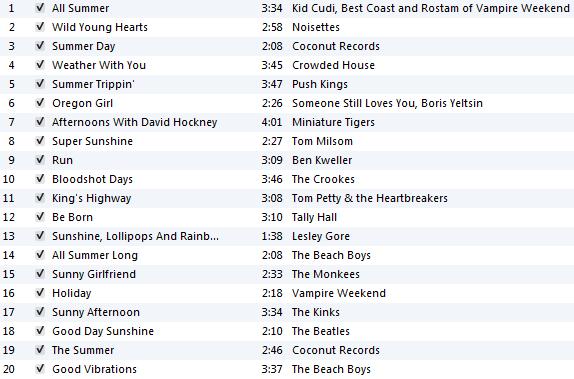
It's just over a week into summer and the temperature in my area has already shot above one-hundred degrees. I'm not sure how much of a damper this will put on the ability to frolic this year, but it's certainly a good indicator that the season is upon us. I am an irresponsible blog-runner in that I have not yet given you an awesome playlist of recommended songs for the summer. Bad me. But now (a week late, I know), I have risen to the occasion and would like to present you with a summer playlist. Not all of these songs have to do with summer directly, many were just chosen for mood they seem to convey or the tempo (explanations after the image).

"All Summer" by Kid Cudi, Best Coast and Rostam of Vampire Weekend
This track was released for free a couple of years ago to promote Converse shoes. It's still available on the website, and I happen to think it's a solid song.

"Wild Young Hearts" by Noisettes
With a similar feel and energy to that of "All Summer," "Wild Young Hearts" is a great tune for jumping around in the sunniest season.

"Summer Day" by Coconut Records (featuring Kirsten Dunst)
Much more down-tempo, this song is better to listen to whilst lazing about drinking lemonade and whining about how hot it is.

"Weather With You" by Crowded House
Crowded House tends to have a spring/summer sound to them, but this song definitely feels summery to me. The song is about creating your own mood or "weather," so I suppose it suits whatever season you want it to.

"Summer Trippin'" by Push Kings
The all-but-vanished 90s band Push Kings are survived by Carrick Moore Gerety's more recent band Everybody Else, but should not be forgotten. I feel like this particular song has a lot in common with Crowded House, and has all the fun of a 90s pop song without the pain of being a typical 90s pop song.

"Oregon Girl" by Someone Still Loves You Boris Yeltsin
A play on 60s surf songs like "California Girls," "Oregon Girl" is a great summery song for those who know that there are also attractive girls in states apart from California.

"Afternoons With David Hockney" by Miniature Tigers
This is a track from Miniature Tigers' latest album. I picked this song as more of a mood song. It has a floating, lazy feel to it that I think suits a summer playlist.

"Super Sunshine" by Tom Milsom
Talented multi-instrumentalist and Youtuber Tom Milsom presented this track on the first of his Explorers albums. It's a fun and intricate piece that can be purchased here.

"Run" by Ben Kweller
Ignoring the obvious grammatical errors, this is really a good tune. The feel of freedom and ease lends itself well to a summer playlist.

"Bloodshot Days" by The Crookes
This is a rather sad song, but I still feel like the instrumentals fit the playlist. I guess we just have to assume that summer isn't all pleasant frolicking.

"King's Highway" by Tom Petty and the Heartbreakers
A far more optimistic song than its predecessor, this song always makes me feel hopeful.

"Be Born" by Tally Hall
I chose this pleasantly lazy song about an unborn child because it's a perfect melody for a summer day whether you catch the meaning or not.

"Sunshine, Lollipops, And Rainbows" by Lesley Gore 
By an artist who could truly convey the innocence and happiness of young love, this is a tune that can make you very happy and optimistic if you let it.

"All Summer Long" by The Beach Boys
Like them or not, The Beach Boys sure do go hand-in-hand with summer.

"Sunny Girlfriend" by The Monkees
Michael Nesmith sings of a manic-pixie-dream-girl in a song that is pleasant and upbeat.

"Holiday" by Vampire Weekend
The oft-used-in-commercials "Holiday," like many Vampire Weekend songs, is great for warm weather. The video is quite nice too:


"Sunny Afternoon" by The Kinks
The moods of the lyrics and music match up perfectly in this tale of a lazy day in the life of a man who finds himself recently unentangled.

"Good Day Sunshine" by The Beatles
The Beatles sing about sunshine from time to time, but the effect is never as unapologetically optimistic as in "Good Day Sunshine."

"The Summer" by Coconut Records
Jason Schwartzman presents another fun summer song. Really, most Coconut Records songs are reminiscent of summer, but this one is blatant about it.

"Good Vibrations" by The Beach Boys
I close this playlist with another track from the most summer-centric band of all time.


Other suggestions? Drop me a comment.

Tuesday, June 12, 2012

Concert Review: Feist in Columbus, Ohio

Last Wednesday, I had the pleasure of seeing one of my favorite vocalists, Feist, live at the Wexner Center. The Wexner Center, as a venue, is not a rock setting, but it's definitely great for performances. The acoustics are possibly the best I've experienced at any venue.

The Low Anthem opened, playing a folky and Bob Dylan-esque set.

The Low Anthem

Having never heard The Low Anthem before, I was very impressed. They have a warm, rich sound and definitely know their way around musical instruments and concepts. I've never seen the saw played onstage before, and would love to again.

Feist and her band took the stage after a short wait and jumped right in with "A Commotion." I liked the live version of "A Commotion" much better than the album one. Such was not the case with "How Come You Never Go There," which was for some reason sped up immensely, so that it was almost unrecognizable. They carried some of the tribal sounds from Metals over to a version of "Mushaboom" with heavy drum beats.


Things began to sound more like the Feist of the earlier albums with "The Circle Married The Line," which I think is one of best songs from Metals, followed by "I'm Sorry." They played "Graveyard" in a style much more similar to something from Let It Die, flowing into a haunting "My Moon My Man," with a keyboard part far more unsettling than the album version. The whole song was played in a very rocky and somewhat staccato style unlike (but not worse than) the album version.


"I Feel It All" was made far more upbeat, causing most of the audience to stand and dance or clap. For some reason, it was performed twice, to no one's disappointment. Next up were three more songs from Metals; "Anti-Pioneer," "Bittersweet Memories," and "Undiscovered First." "Bittersweet Memories" turned out to be a fairly moving performance.


They played a version of "The Limit to Your Love" in which the beats were made more prominent and heavier. Afterwards, Feist drew attention to the backing vocalists, a trio called Mountain Man. Mountain Man performed a short song acapella, and then the band returned with "The Bad In Each Other," which, like "I Feel It All," they chose to play twice.

They closed the set with three more songs from Metals; the lovely and tragic "Comfort Me," "Caught a Long Wind," and a surprisingly beautiful "Get It Wrong, Get It Right."


For the encore, they opened back up with "Cicadas and Gulls." During the song, the bass/keyboard player danced topless backstage and was projected onto the background screen. Much of the audience and some of the band found it difficult to concentrate on the song with the interpretive dancing going on. Next, they played "Sea Lion Woman" from The Reminder, which was essentially everything I hoped for. The show concluded with a keys-riddled "Let It Die."

Seeing as I was not a huge fan of Metals, and the entire album was dispersed through the set, I was quite impressed with the show. Feist is a good performer who is lively onstage and able to engage the audience well. Her band and Mountain Man are also able to hold their own in terms of talent. I wouldn't recommend Feist if you're looking for a rock show, but she certainly gives a good performance.

Thursday, May 31, 2012

Album Review: Aren't We So Lucky To Be Alive? by Elias and the Error


As we dive deeper into the depths of the digital age, it becomes increasingly difficult to tell the difference between the production of a platinum-selling artist and someone with their own equipment and software, producing their own music. Elias and the Error don't have all the finesse of a major label recording artist, but they do a pretty great job.

Aren't We So Lucky To Be Alive? starts off strong with the Mark Mothersbaugh-infused "All You Ever Think About Is Death," which is poppy and intricate, while still conveying a message. "Evil" is a little bit different, with a very 80s synth line. It's definitely an interwoven piece, but some of the repetitive vocal effects can be tough to stomach. "Get This Fag Out of Here" is a successful message song, while still being quite high-energy.

The vocals on "Alex" seem to borrow slightly from David Bowie. "Alex" is a decent track with beautifully functioning synths, but there is a deliberate clash between the vocals and the music that doesn't really suit my style. One of the strongest dance songs on the album is "I Knew You Before You Were Rich," which is fairly repetitive, but not in a way that is grating.

From here, the album moves on to "Aren't We So Lucky To Be Alive? Part 1," which is for some reason introduced by narration. "Aren't We So Lucky To Be Alive? Part 1" doesn't suit my tastes at all, though it's similar to noise-pop. Later on in the album come "Aren't We So Lucky To Be Alive? Part 2," "Aren't We So Lucky To Be Alive? Part 3," and "Aren't We So Lucky To Be Alive? Part 4," which vary in levels of musicality. It's interesting the way all four songs explore the same concept of the title, but with varying instruments, musical styles, and possibly even life-views.

"Always At Odds" features a great underlying keyboard part, which makes the song. The use of electric drums or drum machines is also notable. "Riot" starts out like the lovechild of Devo and Wolfmother. As catchy as "All You Ever Think About Is Death" is, I think "Riot" is probably the most solid song on the album. "Ghost Man, Man" seems to pull heavily from Of Montreal, while "My Sex" has a rough, noisy sound, much like then end of "Aren't We So Lucky To Be Alive? Part 1."

Another dance-style track is "Now I'm Fine," the redundancy of which is once again tolerable. One of my favorite tracks is "Kanuu," which starts with soft synths and develops into a sound that is constant with the one that has been developed over the course of the album. I can't help but be reminded of Of Montreal's "Gallery Piece" when I hear Elias and the Error's "Mijuana," although they aren't really musically similar.

The last three tracks on the album are all strong, but it closes with "B Where U R," a catchy and musically sound song which perfectly encapsulates the band's sound, without borrowing very much from anyone else.

My complaints about this album are fairly few. I think it could do with a little less unresolved dissonance and clashing, but I gather that's part of their sound rather than a mistake, which is good. Some of the choices aren't really consistent with the style of music I listen to, but I know it's a style that many other people enjoy. I'm sure that by the next album, Elias and the Error will have discovered more of their own style, and will borrow less and less. I look forward to seeing where Elias and the Error go in the future.

Elias and the Error is an electro-punk art collective from Canton, Ohio. Elias Gowins produces and 
performs the music, and the visual experience is handled by a collective known as "The Error."

Aren't We So Lucky To Be Alive? can be found here.

Thursday, May 17, 2012

Emma Hath a Song: "Creep"

Some people consider Radiohead to be the mother of modern independent rock. It's interesting to realize that they made such a powerful introduction to the world as "Creep."


Thom Yorke wrote "Creep" in the late 80s, while attending Exeter University, before the formation of Radiohead. Yorke gave a demo version to bassist Colin Greenwood, to get him to help put the band together. When initially released, "Creep" performed horribly in the charts, and only received considerable attention when it was re-released a year later. When the band recorded "Creep," they referred to it as their "Scott Walker" song, making the producers think it was a cover. Guitarist Jonny Greenwood thought the song was too quiet, and he tried to mess it up by playing the hard noises just before the chorus. Yorke loosely based the melody of the song on "The Air That I Breathe" by The Hollies. After "Creep"'s release, Radiohead gave credit to Albert Hammond and Mike Hazlewood as co-writers due to the similarity.


Yorke has said that the song is about a man who tries to get a woman's attention by following her. Supposedly, Yorke wrote the song from his own point of view. The concept of not feeling good enough for someone you have a crush on is easy enough to understand, but Radiohead have reportedly received fan mail from murderers, telling the band how much they could relate to the song.

Radiohead were reluctant to create the radio-friendly version of "Creep," feeling it would imply that they were selling out and that it would disturb the sentiment of the song. Yorke felt the song lost its anger due to the edit.

"Creep" has been covered many times in many varying styles. As early as 1995, The Pretenders performed a moving cover for The Isle of View, almost making it sound like it could have been written by Chrissie Hynde.


More recently, "Creep" has been covered by artists from Kelly Clarkson to Prince. Youtube artist Tom Milsom performed it on the harp at the first Vidcon online video conference. A haunting choral version by Scala & Kolacny Brothers was used in the trailers for The Social Network.


The public remains interested in this song, and in covering this song for fairly obvious reasons. Whatever stalker qualities it might have, "Creep" comes from a deep emotional place, one that many people have either been in or can empathize with. The melody, however simple, is moving.

And that's all that I hath for now.

Sunday, April 29, 2012

Concert Review: Eric Hutchinson in Columbus, Ohio

It's been almost four years since I last saw Eric Hutchinson. His live shows are well known for being spectacularly amusing as well as genuinely good, and Friday night's show once again lived up to the hype. The A & R Music Bar is a little bit smaller than The Basement, where I saw him last time, but it was packed.

As soon as I heard about opening act Anya Marina, I knew I'd heard of her before, but I couldn't figure out where. The songs she played sounded cute and I assumed I must have heard one of her songs on Pandora. Like Hutchinson, Marina had a great rapport with the audience. There were some children in the front row that she talked to between almost every song.

Anya Marina

I don't have a lot to say about Marina's set because I wasn't especially impressed or unimpressed with it. It all sounded good, but being unfamiliar with the songs took most of the fun out of it. On her final number however, I did discover where I'd heard her before. As a closer, Marina played a cover of T.I.'s "Whatever You Like" that my college roommates listened to over and over again. Her cover makes the tune somewhat haunting and a little more catchy than it started out. I highly recommend it.

There was quite a lengthy wait between sets. I'm not sure what the complication was, but it seemed to take a while. Eric Hutchinson and his band finally took the stage and launched straight into "Best Days." Hutchinson engaged the crowd, asking them to sing along as much as possible.


They played a couple of songs from Sounds Like This, followed by "Not There Yet." The reggae beats in "Not There Yet" were used to lead into a lively and quick cover of The Beatles' "Ob-La-Di, Ob-La-Da." After that, Hutchinson played "All Over Now" and "Outside Villanova" from Sounds Like This and then introduced "Breakdown More." I learned that "Breakdown More" was originally released on his first album, That Could've Gone Better, which is now out of print.


Another staple of Eric Hutchinson concerts is songs made up on the spot about the audience. Hutchinson created a song about the inconveniently located pillars in the venue that was not only musically sound, it was also quite funny. Next up was the lead single from Moving Up Living Down, "Watching You Watch Him." The crowd loved the energy-riddled sad song. The energy of "Watching You Watch Him" provided a stark contrast to the intensely emotional "Back To Where I Was," for which the rest of the band left the stage. Still solo, Hutchinson moved on to a frequent cover, "Stand By Me." 

The band returned for two more songs from the new album. They ended the set with "Food Chain" and "Okay, It's Alright With Me."

There was a very short wait before the encore, which started with a cover of Sublime's "Santeria" that really sounded like an Eric Hutchinson song. I was completely unfamiliar with the song and couldn't figure out why so much of the crowd knew it so well. They closed the show with "The Basement" and finally Hutchinson's biggest hit "Rock & Roll."

Eric Hutchinson still puts on one of the best shows you can go to see. I can't help feeling there was a little less energy to this one than the first of his shows I went to, but it was still incredibly good.


Special thanks to my brother for snagging a set-list, which made it much easier to complete this review.