Tuesday, April 12, 2022

Album Review: Further Joy by The Regrettes


I have no idea how many times this will need to be repeated in the coming decades, but: the lockdown was hard on everyone. The effects of the pandemic on us as a society are still being researched in an attempt to understand it from every angle. For performers, the pandemic was a huge lifestyle change. Many took to livestreaming as a surrogate for live shows, but it could never be the same. As an avid fan of live music who worked all through the pandemic, I can tell you that I didn't tune in to many livestreams even though I would have taken the time off for an in-person show. It just isn't the same. There's a kind of energy you get from the band and that they get from you that can't be replaced. Frontperson for The Regrettes, Lydia Night says she suffered from the lack of live performing. Many songs on the new album address anxiety (which, no surprise, is a symptom that has increased exponentially since the pandemic). Night channeled her anxiety and stress into a therapeutic songwriting process. That process seems to have yielded the band's 2020 release "What am I Gonna Do Today" as well as many songs on Further Joy. Night has spoken in-depth on the topic, saying; "Part of the healing process for me is really learning and trying my best to keep on dancing the pain away so I hope people can relate to that and dance with me."

This brings us up to the current day now that Further Joy has been fully contextualized. It's a departure from their earlier music just as our world is a departure from the way it was in February of 2020. The band's confident pop-punk is now joined with a '90s pop sound. Night channels Gwen Stefani and even Donna Lewis' soft and floating vocals, in doing so showing her own voice off. It lets you hear her range. Bands pivot to other genres all the time, but rarely for such a good reason. 

Further Joy kicks off with "Anxieties," which introduces the feeling to the album. The intro and first verse are accompanied by something akin to a half-wall of sound produced by Tim Pagnotta. The synthesizer and glockenspiel part that opens the song continues through the first verse, creating a sense of monotony and anxiety. When it breaks at the chorus, the relief is palpable. The chorus is introduced by drums before transitioning into an ethereal, quieter part of the song. Thus, the song is able to convey the sentiment of the lyrics before you even know what they are. The lyrics to "Anxieties" cover many ways we can feel and express our anxieties, from constant crying to negative and painful thought distortions that lower our self-esteem. Despite the constant worries, the message of the song manages to be somewhat positive thanks to the constant mantra of "knock me down down up back down//knock me down I won't back down." The themes of the lyrics are echoed by the music video, whether Night is looking in a funhouse mirror that distorts her self-image, sitting with several spotlights on her, not knowing what to do with her hands, viewing the whole world in a distorted manner, or seeking plastic surgery despite the fact that there's absolutely nothing wrong with her. "Anxieties" makes its point in every way, making it an incredibly effective pop track.

"Anxieties" is immediately followed by my favorite track on the album, the earworm "Monday." "Monday" would fit in on one of their earlier albums with relative ease, yet it also indicates a great deal of musical growth. "Monday" covers similar topics to "Anxieties," even including another reference to uncontrollable crying ("I swear it's just my sinuses I'll be fine"). Musically, the song does something I find brilliant, whether it was fully intentional or not. The beginning of the song brings to mind "Smells Like Teen Spirit" with the guitar rhythm and some of the chord intervals. As the song moves into the chorus, the bass synth part takes on the piano part from "Baba O'Riley" and then the song shifts back and forth between these two movements. The video for "Monday" takes place at a high school dance. Between the video, the lyrics about "these growing pains they push me 'till I break," and the fact that the song calls upon two of the most seminal songs about teens, I am inclined to believe that "Monday" is, in part about teenage anxiety. Guitarist and keyboardist Genessa Gariano told  Consequence Sound: "Personally, I’ve been carrying the anxiety backpack around since I was a kid. I know from conversations I’ve had with friends, that they’ve related to that experience too." Teenage thoughts and troubles don't stop just because we graduate high school. 


Next up is "That's What Makes Me Love You," a reggae-beat driven song reminiscent of No Doubt or The Cardigans' "Lovefool." It's a sweet song about a young relationship, but it doesn't portray the relationship as all roses. For the third song in a row, there are references to crying. Night says the song was about her getting over her relationship anxiety; "I would look at any argument or tense conversation as a sign or scary thing, making it mean so much more than just a simple conversation. I got out of that place by realizing, 'I love this person for exactly who they are and nothing needs to change.'[...] The song came from me flipping the narrative in my own brain to 'That’s not why I should be scared. That’s why I love you.'" 

The following song, "Barely on my Mind" is a total 180 from the topics of "That's What Makes Me Love You." It's a song about an undeniably toxic relationship that the narrator has left, but still can't shake. Night describes everything from "high highs" (a staple of emotionally abusive relationships, as they make you think this person could be the one after all) to "no sleep//400 miles away you control me" and "follow me around//hold me 'till I drown." The bridge covers the same topic as "I Knew You Were Trouble" (feeling as though this person was bad news from the beginning, yet still proceeding and kicking yourself later) with "I had a feeling and no, I wasn't wrong//I had a feelin' you were a devil in a fancy suit." Night pulled this relationship straight out of personal experience, saying: "That song for me was processing [a] shi**y relationship because it doesn’t go away, it doesn’t just disappear." Musically, "Barely on my Mind" has an intro and underlying instrumental reminiscent of Tame Impala, with a string sting popping in occasionally that plays like one of Jeff Lynne's production choices. Night stays close to "That's What Makes Me Love You" with a vocal similar to Stefani again. This is in no way an indication that the song is a facsimile of other artists' material. Quite the contrary; the elements of artists that The Regrettes are pulling from adds complexity to their work. The two songs may be completely disconnected, but there is a musical continuity between "That's What Makes Me Love You" and "Barely on my Mind."


"Subtleties (Never Giving up on You)" takes on body image in a manner that almost sounds like a love song. That is, until you give it a deep listen and realize it's the narrator's own body she is trying to love as she's "stuck in you forever." I love the way this song is able to convey feelings of insecurity and living uncomfortably within your own skin. My favorite line goes: "easy to preach it when you're not//naked in the mirror yelling affirmations just to find a thing that you believe." "Subtleties" acts as a love song about trying to fall in love with yourself, but came from a dark place for Night, who has struggled with eating disorders since the age of 15. The chorus is very singable and the production by Tim Pagnotta once again begs for your attention.

The external anxieties are back for "La Di Da." Night describes feeling an anxiety attack coming on through an otherwise great day. All she can do in the song is push it down and give herself nonsense to sing so that she doesn't focus on the panic creeping in. "La Di Da" is one of the most upbeat songs on the album, bringing to mind a '90s or early '00s Europop song, particularly at the chorus. All of the collective noise of the verses and choruses really makes the bridge more impressive within the context of the song. It's quiet and uplifting, feeling like a break from the stresses. A slight, gentle Burt Bacharach brass part pops in with the melody above sustained strings and chimes. When the drum beat returns, the song remains peaceful: not something you would dance to, but something you can "vibe" to. It seems as though the "La Di Da" mantra has begin to work for her, and now it's offered as advice. 

Although "La Di Da" is also produced by Jacknife Lee as well, "Homesick" and "Better Now" sound more closely related as a pair. Lee's production crosses between modern pop and the synthpop/post-punk sound of bands like New Order. This production works perfectly with the guitar sound, which is reminiscent of The Xx during their first album, and the bass, which brings to mind the work of Simon Gallup. These two songs discuss very different topics, with "Homesick" being a genuine song about Night missing her boyfriend and "Better Now" about the hindsight one experiences when looking back on previous unwarranted anxieties.

"Rosy" is one of the most poppy songs on the album, but a mesh of modern and turn-of-the-millennium pop. As lightly implied by the title, "Rosy" is about wearing rose-tinted glasses. The narrator is so happy in her new relationship that she doesn't see anything negative about the situation. Even though at one point she mentions that he "had a girlfriend," I can't see anything negative about the relationship either. It's a song that's upbeat and fun, and the lyrics send you to a charming place. Everything works together very well. The only downside to "Rosy" as included on this album is that the anxieties mentioned in the song are "cured" by her crush, which we know is not sustainable. Night was aware of this, stating "I had to learn not to let all my highs exist with someone else because placing that sort of pressure on a relationship is not healthy. I think it’s better to not have those glasses on." As high as the emotion gets in "Rosy," it immediately drops to a much lower place for the ballad-like "You're So F***ing Pretty." "You're So F***ing Pretty" is a childlike, regretful tale of a missed romantic opportunity. Gariano drove the songwriting process for this one, pulling from a real story of a crush on a friend. Night, however, had her own experience to pull from as well. Drummer Drew Thomsen told Consequence Sound "It started out like this Fleetwood Mac song with a big stomping kick." Producer Tim Pagnotta suggested that the subject matter of the track would make it more effective as a piano song.


"Step 9" and "Nowhere" return to faster tempos. Both songs are somewhat nostalgic, but not in a good way. "Step 9" is about not fully forgiving someone for their former toxicity just because they're sober now. The title, "Step 9" is an obvious reference the the AA Twelve-Step program, step nine of which is "Make direct amends to such people wherever possible, except when to do so would injure them or others." "Nowhere" is another song about body image and anxiety as well as the lust to find happiness in hitting goals, with the standout line being "not a single pore, I really can't relate//hey, but if I had that skin you know I'd still complain." Most issues with body image are unavoidable, as everyone wants something they don't have physically. In addition, however, feelings of depression and anxiety come not only from comparing ourselves to others, but from expecting external success to validate us within ourselves.

In my opinion, a good album closer acts as a thesis statement for the album. "Show Me You Want Me" incorporates many ideas from the album. The sound of the track sums up some of the other musical themes explored, but also brings a high energy to wrap up the album. The lyrics once again touch on insecurity and romance. Night sings "and if you take away the stage am I something you can see through," which for me, brings to mind her quote about being a performer during lockdown: "as LA locked down, I felt a huge part of my identity and ego being stripped away because of no touring, and no connecting with people at our shows."

If this album has one flaw, to me it is that the songs are arranged with the very strongest ones on the first half. The other songs are good, but not as good. Apart from that, the album is solid. Night's lyrics are complex and at times prove that you can say simple things in interesting ways. The exploration of sound gives the band new depth and versatility, which will open up even more opportunities for songwriting in the future. Lydia Night as a frontperson has always had a lot of attitude and confidence, yet here is often vulnerable. I hope young fans who saw her persona as a goal will now be able to see that they too can be who they want to be, even if it's a great deal of hard work to get there.

The Regrettes are a punk/rock/pop band from Los Angeles.


Further Joy is out now and can be purchased on vinyl here.

Thursday, April 7, 2022

One-Mind Tracks: We Don't Have to Grow Up

A common criticism of my generation is the idea that we all have Peter Pan syndrome. Supposedly, we all want to stay children forever, no matter how full our facial hair is. Now, I'm not going to blame all of this on the generation before us, but I do distinctly remember every '90s commercial being about how awful adults are and cartoons with parents who were completely devoid of personality. We grew up thinking that being an adult was boring and so it's no surprise that we're reluctant to "grow up." Heck, even this ad for Toys 'R' Us (rest in peace) was telling us not to grow up. 


I think my generation is learning to excel at something special though; we are staying young at heart. The term "adulting" is everywhere and some people really hate it. I've done a 180 about the phrase. At first I didn't like it because I dove headfirst into adulthood as soon as I could...but I've also never felt like an adult. Not even now, at 30. "Adulting" speaks to a larger topic than just doing things the grown-up way or being over an age line. "Adulting" means doing the mature and responsible things you have to do. It implies that you have other times when you can embrace things not considered to be mature. Maybe you're skateboarding, building a Lego masterpiece or just hanging out with your friends and playing video games until late at night. That's perfect. My favorite thing about being an adult is getting to combine traditional "adulting" with a continued love for the things I've always loved. I don't have as much time as I used to, but I love wearing bright, silly outfits. I love having Barbies and toys. They might not be used as much as they used to be but it's all part of just staying young inside. Like what you like, do what you do. That's what this playlist is about also.

"Stay Young, Go Dancing" by Death Cab For Cutie
I picked this track very early on in my planning process. Lead singer/songwriter Ben Gibbard has stated that this track was partly inspired by his then-wife, actress Zooey Deschanel. The declaration of "life is sweet in the belly of the beast" is a reference to him coming to enjoy Los Angeles, a city he nicknamed "the belly of the beast" previously. "Stay Young, Go Dancing" is most likely about a long-term relationship. Yet, it says so much more than just that they'll grow old together. "Through winter's advancing//we'll stay young, go dancing" is a promise that the couple will stay young together even as they age. It's a beautiful sentiment.


"Forever Young" by Bob Dylan
Dylan wrote this one in Tucson, Arizona as a lullaby for his eldest son, Jesse. He had been missing his son, but didn't want to get too sentimental. His album Planet Waves contains two versions of the song: one fast and one slow. "Forever Young" is a lullaby. but also a blessing. Dylan is calling for his son to have many grown-up attributes while still holding onto his youth.


"Patience" by Tame Impala
Kevin Parker of Tame Impala sings of the persistence of time and that "time takes from everyone." His version of staying young is "growing up in stages." Adulthood isn't a black-and-white instant transition, it's a series of decisions. One of those decisions can always be to stay young or to keep some forms of childishness as you gradually add adult responsibilities on.


"Innocence" by Avril Lavigne
Avril Lavigne begs us (or rather, herself) to hold on to innocence. Too often, this is the first thing we lose in our adulthood. Obviously, there are elements of innocence that we typically don't keep forever. "Innocence" isn't about those things though. It's about the appreciation of simple things, giving ourselves the ability to feel truly happy. Adults can be jaded by so many things. Lavigne (and Evan Taubenfeld) just remind us to keep our feelings of positivity close. They remind us to appreciate beautiful and wonderful things in life (which is always a huge element in staying young at heart).


"I Don't Wanna Grow Up" by The Ramones
The long list of things The Ramones don't want to do includes growing up. Tom Waits wrote and originally recorded this song. The Ramones covered it three years later for their final album, ¡Adios Amigos! It totally fits their style, but of course I do want to talk about Waits' songwriting here. Waits has always been a non-conformist so his assertion that he doesn't want to grow up is almost like a mission statement. Not growing up can sometimes just mean not conforming to what society thinks you should do because you're over 18. As long as it isn't hurting anyone, you can do whatever you want to as an adult. It doesn't mean you have to grow up though!


"Give Yourself a Try" by The 1975 [explicit]
The 1975 wrote this track with both autobiographical and fictional elements in an attempt to capture social anxiety and pressure as millennials experience it. The overall message of the song is to have a little faith in yourself. To me, a big part of why my generation doesn't want to grow up seems to be the fact that many of us have low self-esteem and are afraid of failing if we trust in ourselves enough to go for the big, adult life. 


"Alright" by Supergrass
It's amazing that this 27-year-old song seems both more modern and more retro than it is. Lead singer Gaz Coombes stated that the song was not intended as an anthem, but a message to the age group they had recently left, young teenagers. Coombes was nineteen when the song was written, and it was intended as a playful song for those just entering their teen years. In defense of its inclusion on this list, however, I present to you the lyrics, "Are we like you?//I can't be sure//Of the scene, as she turns//We are strange, in our worlds." It seems these teens Coombes imagines are already unsure of their place in the world. They don't know if they're "adults" or not. Of course, we know they aren't, but if we imagine the song being about older people, it does speak to the vulnerability and uncertainty one can feel when not feeling as though they're quite "grown-up."


The One-Mind Tracks Single of the week: "Colorful" b/w "Boring" by Jukebox the Ghost
One-Mind Tracks on the air has started doing a weekly "single," where we take two related songs and group them together. It's not a real single, but please pretend with us. This week, both songs on the single come from Off to the Races, a 2018 album by Jukebox the Ghost. Much of the album explores the topic we're discussing. These two songs are the most relevant to the playlist. "Colorful" says "work hard, play hard//we don't have to grow up" while "Boring" bemoans the fact that the people around the vocalist (Tommy Siegel) are all growing up and "getting boring." He realizes that it's inevitable to "get old and boring" and his best defense is to embrace it. He suggests that the object of his affection is not boring, but even at that, he is fine getting old and boring with her. "Colorful" is the thesis of this whole playlist. We can do all of the adult things required of us without "growing up."


"Changes" by David Bowie
David Bowie wasn't speaking on this theme per se, but the lyrics see a man looking at his younger self and his ideas of success that never panned out. Lines like "don't tell them to grow up and out of it" imply a defense of the young dreamers. Bowie also uses the line "time may change me//but I can't trace time." To me at least, that line says that he recognizes that he's grown older and more mature, but he still doesn't view himself differently because he doesn't even register that a great deal of time has passed. 


"Forever Young" by Rod Stewart
This Rod Stewart track closely follows the formula of the Dylan song from earlier. I think each of these songs are beautiful, even if they serve essentially the same purpose. Stewart doesn't hope for them to "stay forever young" as Dylan does, but he does say that if they follow his advice, they will be forever young in his heart. Stewart wrote this song with his bandmates: guitarist Jim Cregan and keyboardist Kevin Savigar. Like Dylan, Stewart wrote this song for his children. 


"Child" by Lights
Lights wrote this song while pregnant with her first child. The song is an expression of her anxiety leading up to becoming a mother while still feeling like child herself. She sings "what do I know//I'm just a child//trying to talk like a mother does." Lights ends the track with "maybe I'm still trying to see like a child does." Lights is struggling with both ends of the "growing up" in this song. She worries about her ability to "adult" while still hoping that she'll be able to hold onto her childlike qualities.


"Unbelievable" by Owl City (featuring Hanson)
The main theme of "Unbelievable" is nostalgia, which the song relies on heavily. That said, the chorus keeps bringing up the line "you haven't seen nothing yet." To me, that line expresses Owl City's trademark optimism that no matter how awesome the past may have been, there are great things still to come in adulthood. 


"No Guilt" by The Waitresses
Though it's primarily a break-up song about getting on fine without your ex, "No Guilt" makes it onto the list because of how proud the narrator is of her adult responsibilities and handling her life herself. Finding joy in your life is a big part of staying young at heart. 


Catch these songs on the One-Mind Tracks radio show this week! The show starts at 7PM EST on Thursday. You can catch it streaming over at 985winf.com. Or you can catch an episode of One-Mind Tracks any Thursday at 7pm!

Feel free to let me know in the comments if you have a song that fit the theme!


P.S. I didn't watch the video for Rod Stewart's "Forever Young" at first but I kept looking at the video's thumbnail. It wasn't until I put it in this article that I realized that's a real kid and not a ventriloquist dummy. I thought it was set to be a really strange video.

Saturday, April 2, 2022

I've Got This Covered: The Beatles: Let it Be

I shall forever be a great defender of cover versions of songs. I just love seeing what artists can do with one-another's work; what they can add, what they can make their own about it. "I've Got This Covered" is making an official comeback after four years of retirement in order to celebrate The Beatles Get Back movie (and the accompanying concert film and Rock and Roll Hall of Fame Exhibit and I don't know, there's probably a tie-in with Fruit-by-the-Foot at this point). "I've Got This Covered" is an article series in which I imagine which artists could do great covers of (in most cases) a full album. Today, my choices were influenced by AJ Ward.

1) Two of Us - Tegan and Sara
One of the biggest takeaways from Get Back is realizing how close The Beatles had gotten after years of writing, playing, and generally being around one-another. Not only was Two of Us the name of another Michael Lindsay-Hogg film (Lindsay-Hogg was the director of the original Get Back footage, for those not in the know), it's also the title of a song (obviously) that perfectly sums up John Lennon and Paul McCartney's strained-yet-loving, brotherly creative process. We considered Ben Gibbard for this one, since his voice would suit it well and his acoustic prowess would be a great match. But Tegan and Sara would be able to both harmonize on the track and to bring to the table some of their own relationship as sisters and collaborators. Tegan and Sara have already covered another Beatles song, "Lovely Rita" in collaboration with The Flaming Lips, Stardeath and White Dwarfs.


2) Dig A Pony - Orville Peck
Orville Peck uses equine imagery throughout his work. He has the wide vocal range necessary for this song and his glam-country sound would give it a twist while still fitting with the sound of the original. 

3) Across the Universe - Tame Impala
AJ and I compiled our lists separately, yet we both picked Tame Impala for this one without a second thought. Kevin Parker of Tame Impala would presumably throw on a lot more reverb (more of a post-Beatles Lennon sound). We also imagine him coming in on a funky bassline with the vocals and adding drums just a bit further on. While Parker doesn't consider himself to be a huge Beatles fan, his song "Yes I'm Changing" has been perfectly mashed up with "Imagine" by Sam DeMartino. Parker has also covered John Lennon's "Jealous Guy." 


4) I Me Mine - The Raconteurs
This one was tough to decide. We couldn't figure out who could handle the soft, sad and gentle tones of George Harrison in the verse as well as the rough-and-tumble raucousness of the chorus. Luckily, AJ thought of Jack White for the guitarwork on the chorus and we decided that the The Raconteurs would be a perfect fit for this song. Brendan Benson would handle the gentle, melodic verses and Jack White could rock hard on the choruses. Problem solved. (Side note: Jack White, I come to you as a blue hologram of myself. If you're reading this, please make this happen. If there's anyone on this list I trust to get things done, it's you) The Raconteurs have already paid tribute to The Beatles in their own way. Some copies of their 2019 album Help Us Stranger contained a parody of The Beatles' famous "butcher cover" hidden under the real cover.

5) Dig It - Cake
Short but sweet, this track would have probably been nothing more than a studio outtake if the album had yielded more tracks. Since it made it onto the album, we can imagine nothing better than letting Cake have a go at it. John McCrea's unusual vocal stylings would be perfect for the format of the song and the rest of the band could come up with some wild interpretations as well.

6) Let it Be - Regina Spektor
This song was hotly discussed during our planning sessions. Whoever was going to cover it needed to be great at piano and needed to be able to convey a lot of emotion in their voice. Alicia Keys was brought up, Vanessa Carlton, and probably twenty others. No one seemed perfect for it but I was certain that Regina Spektor could handle it and make it interesting. Spektor is incredibly talented at piano and her voice is always rich with emotion. Spektor has previously covered "While My Guitar Gently Weeps," "Real Love," and "And Your Bird Can Sing" (For The Beat Bugs). 


7) Maggie Mae - They Might Be Giants
Another short track, "Maggie Mae" is well-suited for the kings of short songs: They Might Be Giants. TMBG would also bring their own humor to the song just as Lennon and McCartney did. TMBG grew up listening to The Beatles. John Flansburgh remembers A Hard Day's Night being the first album he purchased. John Linnell has even referred to them as "the shi**y Beatles." As a result of all of this, many of their songs have parodied or referenced The Beatles. They've even covered Paul McCartney's "Ram On" and The Beatles' "Savoy Truffle."


8) I've Got a Feeling - Jukebox the Ghost
I've discussed previously how technically great Jukebox the Ghost are as musicians; Ben Thornewill could probably have stepped into Billy Preston's shoes with little effort. Jukebox is also a band with two very strong songwriters who are able to harmonize swimmingly and who both act as lead singer at times (and this is no offense to Jesse Kristin, who is a perfect match on drums). Jukebox the Ghost would power "I've Got a Feeling" with the fun of early Beatles and the musical prowess of the later years. Jukebox the Ghost did a medley of songs from Abbey Road on a French radio station nearly ten years ago.


9) One After 909 - The Nude Party
Sometimes, The Nude Party go in a more psychedelic direction, but not always. Songs like "Chevrolet Van" show us what this North Carolinian band can do in terms of a 50s/early 60s sound, which is exactly what "One After 909" calls for. 

10) The Long and Winding Road - Adele
I'm still not over Adele's voice. Although we threw around the names of other female singers (that seemed to be the constant for some reason), Adele was the only one we thought would be able to carry the depth and breadth of the song. 

11) For You Blue - Ben Gibbard
Long-time readers should know that I love Ben Gibbard's voice almost as much as I love George Harrison's songwriting. This song is strange and sweet. The parts are odd. But we felt that there was no better person to bring it together than Ben Gibbard. His range is fairly similar to Harrison's, and since he knows his way around an acoustic guitar, it's like it was meant to be. Gibbard did a full livestream of Beatles covers during the 2020 lockdown (unfortunately, it didn't include "For You Blue").


12) Get Back - Ben Folds Five
Whoever we picked for "Get Back" needed to be able to rock out. We wanted the piano too. Since Ben Folds is the guitarist and pianist for The Ben Folds Five, we think he can make it work. Folds covered "Golden Slumbers" for the I Am Sam soundtrack.


That's how (AJ and) I think it should go down. Questions? Better ideas? Drop me a comment. Or if you're one of the artists listed above, feel free to make this happen. 

Tuesday, June 1, 2021

Countdown to 30: My Favorite Album From 2020

 2020

In a lot of ways, 2020 wasn't very different for me from any other year. I was blessed to not lose anyone to the sickness and I was working in public through the entire "lockdown" period. I found pleasure in doing a great deal more home cooking and I was able to pay off my student loans thanks to the savings plan known as "no concerts." That brings me to what is probably the biggest change in 2020, the decrease in album releases and the increase in artists playing music from home.

Tame Impala released their first album in five years, The Slow Rush, which contained "Lost in Yesterday" and "Is It True?" The Strokes released their most fun album in years, The New Abnormal. The New Abnormal contained great tracks like "Bad Decisions" and "At the Door." For me though, Eric Hutchinson finally made it to the top of my list.

Class of 98 has to be one of the coolest ideas for a concept album that I've seen in a while. Hutchinson elected to write songs for the album as though he'd written them in high school. The album's release was delayed by the lockdown; changing from April 17th to July 10th. In the shadow of the pandemic and the Black Lives Matter movement, Hutchinson elected to donate a portion of physical album and t-shirt sales to Operation Understanding, a program that helps Black and Jewish Washington DC-area high school students explore each other’s cultures, religions, and histories in-depth.

Hutchinson was able to truly channel both the sound of the '90s and the feelings of being in high school. Justin Sharbono from Soul Asylum plays guitar on the album and Paul Kolderie (producer for Radiohead, The Pixies) was brought on as producer. Sharbono was able to translate Hutchinson's ideas for guitar parts into realities. Hutchinson told American Songwriter, "Justin has this encyclopedic knowledge about the ‘90s. His pedal board was the size of a table and he just had a little bit of everything. I could give him a reference, ‘so let’s go for this guitar sound on this song’ and he could dial it up almost instantly. It was a really fun way to color the songs." Opening track "Rock Out Tonight" channels early Weezer perfectly, with a Cars synthesizer part running under it. Hutchinson sings "If you wanna rock out tonight//I can pick you up in my Ford Taurus//We'll stay out until at least midnight//or until they set a curfew for us." Hutchinson said that his rebellious energy had no place to take shape in small-town Maryland, meaning the lyrics of "Rock Out Tonight" were about as wild as things got. "Cooler Than You" tones back the Weezer influence, but still features the rhythm of "Say it Ain't So." "Cooler Than You" is Hutchinson's response to a bully who peaks in High School. He is willing to take the teasing since he knows he'll come out on top eventually. Despite the '90s influences, Hutchinson's voice makes these songs sound completely original because no one in the era was combining Hutchinson's vocal cadence or soulful style and garage-style backing. 

Hutchinson pays tribute to his late father (Royal Hutchinson) with "My Old Man." The bassline is tribute enough, but the lyrics are a heartfelt love letter to his father, who he didn't give enough credit to in his actual high school years. Hutchinson told Meaww.com, "I didn't necessarily get along with my dad in high school. We were in different places in our lives and he had different things to worry about. I tried to sing this song from my perspective back then as well as my perspective now, where I’ve made peace with him." "Ann Marie" acts as something of a ballad to a friend and friend's girlfriend he had feelings for. Whether or not the story is true is irrelevant as the specificity of the names and situations in the song make it feel real. "Lovely Lori" is another song to a crush. It sounds a little more modern than the rest of the album, but features '90s guitar and a reference to Oasis ("What's your story//morning glory?").

Hutchinson wrote "Good Things Come" for his infant daughter, but it can be applied both as fatherly advice to a child and to young adults in high school, rushing to get to the "good part" of their lives. 

The attitude of '90s slacker-rock finds itself at the forefront in "If They Don't Care (Then We Don't Either)." Sharbono plays a very cool, very '90s guitar solo on the track. The song is about teens who feel as though they have no reason not to rebel, no reason to excel in school, since no one will care if they do. The closest to rebellion the album topics get is, "Drunk at Lunch," which I don't believe needs an explanation.  

A fairly-typical lockdown dinner at the
friend house.
Green Day was an influence throughout the album, but that influence can be heard the most on the intro to album's closing track "Whether I Like it or Not." "Whether I Like it or Not" sounds the most like the '90s to me of anything on the latter half of the album, channeling post-grunge rock with Britpop guitar sounds. 

There's a hidden track too, which Hutchinson says is a prerequisite for a '90s album. I'll let you find that one for yourselves. 

2020 was a very odd year, and this album harkening back to a simpler time may have just been the perfect album for the times. No one wanted a doom-and-gloom album about the present day. Personally, I didn't have much time to get nostalgic in 2020, so I let the album do it for me. Hutchinson is an incredibly talented songwriter. I think setting this challenge for himself was a fantastic idea. I'll listen to any concept album he wants to do next. 

Final leaderboard!


Thank you to all of these artists for filling the first 30 years of my life with wonderful music.

I am so proud of myself for completing this project. This is the most I've written since I wrote a screenplay in college (not bad, considering I have a broken hand). I can't let this creative energy dwindle again, so I'm going to try to channel it into working on a multi-media album/project I was working on very slowly during 2019. I can't really explain it much better than that right now, but I'm more just excited to keep my creative juices flowing. Thanks to those of you who have read all of these articles, it means the world to me!

Sunday, May 30, 2021

Countdown to 30: My Favorite Album From 2019

2019

I can't believe it folks, we're almost there. This is the most I've committed to a project in a very long time.

I already know with 100% certainty what the album of the year for 2019 is. I'll still talk about the runner-up though, because it's not their fault that a perfect album was released the same year.

Vampire Weekend released another piece of absolute art in 2019, after a six-year break and the departure of Rostam Batmanglij. Father of the Bride sees the band exploring more musical styles than usual, and yet for the first time blending lyrical ideas into a somewhat cohesive story. 

Father of the Bride begins with "Hold You Now," which features Danielle Haim (of Haim) and contains the album title. "Hold You Now" is the first Vampire Weekend song to be sung as a duet and to feature a female voice. Koenig wanted to create a duet in which the two singers have opposing viewpoints. The chorus is sampled from the film The Thin Red Line, meaning Hollywood composer Hans Zimmer receives writing credit. Said chorus is sung by the Choir of All Saints from Honiara. The language used it Solomon Pidjin, the native language of the South Pacific Solomon Islands. It roughly translates to: "God, take my life and let it be//Consecrated, Lord, to Thee;//Take my hands and let them move//At the impulse of Thy love." 

My favorite song on the album by far is "Harmony Hall." I felt the song was somehow able to perfectly express my emotions in the year I finally decided to seek medication and help managing my mental illnesses. Of course, there is a great deal more to the song than what my initial listens garnered. The primary refrain of the song "I don't wanna live like this//but I don't wanna die" is a carry-over from  "Finger Back" of Modern Vampires of the City, much as the line "It feels so unnatural//Peter Gabriel too" was a repeated line in their early work. To me, that line expressed a great deal about mental illness. The song itself is in part about feelings changing over time, which may be why I connected to it as someone with bipolar disorder who is all too familiar with feelings changing. Other themes in the song are guilt and anger. In the wake of George Floyd's murder and the BLM protests in 2020, the band Switchfoot went ahead with their release of a cover of "Harmony Hall," explaining a bit more about the song itself in the process. Many have interpreted the title to be a reference to a dormitory at Vampire Weekend's alma mater, Columbia University, but Koenig has disputed this and as Switchfoot frontman Jon Foreman explains in the footnotes to their cover video, "'Harmony Hall' takes inspiration from former slave plantations named Harmony Hall. For me, this is a song that acknowledges that if we are to change our future, we need to first confess our past." "Harmony Hall" has been Vampire Weekend's highest-charting single to date.

"This Life" is cowritten with iLoveMakonnen and Mark Ronson. It covers the theme of love not being as it was expected. A line from iLoveMakonnen's song "Tonight" is interpolated for the chorus, which is about a situation in which the couple have wronged one another equally and have the option to move on or move out. There is also a direct reference to Albert Hammond's "It Never Rains in Southern California," another track about subverted expectations. "Big Blue" features slide guitar reminiscent of George Harrison while the electronic backing track has been compared to Kanye West's 808s & Heartbreak. "How Long?" interpolates Vampire Weekend's own "The Kids Don't Stand a Chance" and the chorus melody of Lily Allen's "My One" (which Ezra Koenig worked on with Mark Ronson the previous year). "2021" is built around a sample of an ambient track entitled "Talking" by Haruomi Hosono. It also features Jenny Lewis in what has to be the strangest guest appearance: simply a distortion of her vocalization of the word "boy."

"My Mistake" details the attempted passage of an immigrant into the U.S. for a better life. The refugee is ultimately caught and says that "Hoping for kindness//was my greatest mistake." Koenig's family came to the U.S. as Jewish immigrants seeking asylum. It's safe to assume he empathized a bit with the Mexican immigrants caught by I.C.E. due to the focus of the Trump administration that left many parents separated from their children.

Father of the Bride explores tough topics with an upbeat sound. It features Koenig telling many stories about an imagined life, an imagined marriage that is crumbling. The album is great at creating a sense of acceptable sadness. It's not the doom-and-gloom emo/goth kind of sadness, just a nostalgic longing for simpler times.

My 2019 album of the year is Beware of the Dogs by Welsh-Australian singer/songwriter Stella Donnelly. I was working on a review for this one back in 2019, and telling everyone I could to listen to it, but I never ended up finishing the review because I hate posting them a long time after the album has been released unless it's able to be a retrospective. I described the album as "the album we need right now" and "an indie pop album for the #metoo era."

Donnelly released an E.P. in 2017 and then Beware of the Dogs two years later. If the title didn't already explain it to you, the opening track, "Old Man" should tell you many of the album themes from the fore. "Old Man" details the exploits of a powerful man who sexually harasses young women, knowing that his position makes it unlikely that the women will retaliate. But the narrator is prepared to ensure that it doesn't happen to another young lady, which suddenly shifts the power dynamic. She also begins to hope that other men will help break the culture. The song perfectly describes the situation without sounding contrived, and it's an example of the kind of situations encountered by professional women all over the so-called developed world. Another song in this vein is "Boys Will Be Boys," a haunting song carried over from her EP Thrush Metal that confronts a friend's rapist and the entire culture surrounding him. It's a quiet, floating tune, capable of giving goosebumps. It also contains possibly my favorite line from the whole album: "Like a mower in the morning I will never let you rest." "Boys Will Be Boys" highlights the importance of men taking a stand against toxic men too, a message essential to the effectiveness of the song. "U Owe Me" describes another negative work environment, and serves as what could be a letter of resignation. It touches on the difference between the amount of work being done by the bartenders and managers and accuses this manager of sexual misconduct as well.

"Mosquito" is a seemingly romantic song. It's dreamy, but still with dark undertones in "baby, you're a light and I'm so attracted to ya//a malaria mosquito buzzing in the shadow." It's a stark contrast to "Allergies," a song which plays like breakup song for the same relationship with mentions of the lover never being home. "Allergies," however, definitely has a more morose feel and is defensive of the narrator's choices. I love the choice in this song to include sniffles as though the song is being recorded during a time of actual allergies (which perhaps it was). "Bistro" also discusses the rift between two lovers who don't often see each other or connect emotionally. It's a breakup song with simplistic but functional lyrics. "Bistro" has the most synthesized sound on the album.

The more I listen to "Seasons Greetings," the less sure I am certain of the subject matter, but it's a catchy, attitude-riddled song. It's angry in a smart-alec way. There's also something about the production that sounds nostalgic, as though I'm listening to it on a cassette. I think it's about a problematic relative. I love the line about "she was a punk//my mum's still a punk and you're still s***."

The obvious single of the album is the upbeat "Tricks," which was the first song to really hook me. "Tricks" is a track about the racist, addict f*boy everyone knows. His "southern cross tattoo" is referenced. The southern cross is a growing symbol of racism in Australia. The song is earworm levels of catchy, while still being simple and meaningful like the rest of the album.

"Lunch" and "Die" are both about reckless drivers. "Lunch" has a soft and slow melody and describes the man as being a bad listener. "Die" begins softer and slower, but develops more of a beat.

The lyrics get most complicated on the title track, "Beware of the Dogs." "Beware of the Dogs" is a highly political message. "Beware of the Dogs" is a warning not about actual dogs, but political figures who are oblivious to those around them, not realizing the power they hold makes them impossible to reason with, not caring how poor many of their constituents are. The chorus is a little more confusing. I don't know why the architect is setting fire to her house, whether it is because they failed to listen to her or something else. 

"Watching Telly" tells the story of an ill-suited matchup between Donnelly/the narrator at 21 and a 27 year-old lover. The narrator discusses a difficult decision she had to make without the help of her unsupportive partner. She also touches on the different challenges women have to face.

"Face It" seems to me to be about a relationship that has lost its trust due to a failing on the part of the man, whether it be infidelity or emotional manipulation. The narrator finds herself paining on her eyes and pasting on her smile to keep up appearances but seems damaged underneath.

Beware of the Dogs
is unafraid to be brutal, unashamed to be raw. It's soft and gentle whilst proudly calling out problematic men. Reviewer Robert Christgau describes the album as "a musical encyclopedia of a**holes." That description is amusing and pretty astute. Donnelly's album proves that you can be a soft-spoken soprano writing folk pop and still have a feminist message. 

Me in 2019 with a non-toxic male- my
boyfriend AJ.
Not only do I appreciate what Beware of the Dogs accomplishes lyrically, it has seriously affected the way I think about writing music now. I realize that I don't have to have a big voice to get my message across. Donnelly's ability to transform the mundane into a compelling story through use of her floating melody lines is another aspect that has influenced me. I actually saw this album on a few end-of-the-year lists, which was surprising but it was not nearly on as many lists as it should have been. I discovered Donnelly through Google Play Music as she was playing in Columbus, Ohio that night. So of course, I didn't get to see her, but I'm so glad I was introduced to her. I'm glad I convinced the man at my favorite Ann Arbor record store to let me have the faded promotional poster from the window, which now hangs proudly in my bedroom. I'm sure this album is a difficult listen for men. I know my boyfriend suffered through a lot of it, feeling the emotional weight and listening to me rant about how important an album it is. Everyone should hear it. Women can learn a lot about expressing ourselves, whereas men can learn a bit about what women suffer through, and problematic behaviors to watch out for. The whole album is simple musically, but incredibly complex and important.

This leaderboard is almost full! Let's take a look!


Join me tomorrow for my final article of this series (for now), my favorite album from 2020.

Saturday, May 29, 2021

Countdown to 30: My Favorite Album From 2018

 2018

2018 was another really weird year for me in which music was often my solace. 

During a period of depression in the fall of 2018 brought on by an unrequited crush and untreated bipolar disorder, my best friend Erin and I went to see Cults for whom the opener was The Shacks. We were instantly enraptured by The Shacks and their retro sound and soft, dreamy vocals. We started going to any Shacks show we could after that. The album they were supporting was Haze. Haze is quirky in the way that only quality musicianship can be. They use omnichord in the title track for goodness sake! Vocalist Shannon Wise has a high, airy voice that floats over Max Shrager's complex retro instrumentals. Haze was what I needed at the moment I was listening to it, but it's amazing however you slice it.

All but one Lily Allen album so far has been in the runners up, so of course I have to mention her 2018 album, No Shame. Many producers worked with her on it but she chose not to work with Greg Kurstin this time as she wanted to prove she could make a good record without him.  

Mark Ronson and Ezra Koenig (of Vampire Weekend) worked with her on "My One," a song about sleeping around but really only having feelings for your special person.

Allen described the album as a "backlash to tabloids," which starts strong on the opening track, "Come On Then." "Come On Then" is about how the press tear people down for entertainment value. Tabloids would make judgements about her personal life as if they knew her, while she spent her time feeling isolated and alone in reality. No one really saw that side of her to know how things were. 

Allen wrote this album after her divorce and an identity crisis about her music. She decided that she wanted to work through her problems with music on No Shame. "Everything to Feel Something" seems to discuss destructive coping mechanisms to mental health issues. "Trigger Bang" featuring Giggs is about Allen's substance abuse issues and the way that people can be toxic to another person's growth process. 

"What You Waiting For?" is about Allen's marriage, her feelings of guilt and regret. "Your Choice" seems to be about a similar topic, but this time focusing more on Allen's annoyance at the jealousy the man seems to feel after her infidelity. Allen's voice is gentle and resigned with some vocal effects added, which contrasts the panicked rap sections by Burna Boy. The next track on this topic, "Lost My Mind" seems to me to be strongest, as it deals with the emotional fallout Allen had to deal with when she and her husband did split. "Family Man" finds Allen at her most self-deprecating about the relationship, though still trying to find a way to fix things. "Apples" somehow gets even sadder. Allen describes the idyllic start to her relationship, the breakdown, and her guilt that she couldn't avoid creating a broken home for her children like the one she had grown up in. 

"Three" is written from her daughter's point of view; she hates seeing her mother go away on tour and just wants her to stay at home. "Pushing Up Daisies" is an adorable, romantic song. I don't know what place it comes from, but it's not as sad a tone as the rest of the album, at least at face value. "Cake" is downright empowering.

Allen is unafraid of writing personal lyrics, which makes for an album that is uninhibited, tragic, and beautiful.

The snippets I heard of Egypt Station on "Carpool Karaoke" piqued my interest. I don't normally watch "Carpool Karaoke" or listen to full, new Paul McCartney albums, but when I heard bits of "Come On to Me" I was sure I wanted to hear the rest. Then I found out the whole album was produced by Greg Kurstin and I had to listen to it. I wasn't the only one. Egypt Station is the first McCartney album to debut at #1 on the U.S. charts, and the first since Tug of War in 1982 to reach #1. 

Egypt Station is a loosely-framed concept album. McCartney explained, "Egypt Station starts off at the station on the first song, and then each song is like a different station. So it gave us some idea to base all the songs around that. I think of it as a dream location that the music emanates from." 

Like Lily Allen on No Shame, McCartney also had some things he was using music to work through. He used "I Don't Know" in such a way, saying of it; "I wrote this after going through a difficult period. Like people have nothing sort of madly serious or anything, but just one of those days when it’s like, 'Oh my god, am I doing wrong here,' you know. And sometimes that’s a good way to write a song, because you’re coming from your soul. And we often used to say that writing a song was like talking to a psychiatrist, a therapist or something. Because you’re saying it… You are saying it in a song rather than in a room to a specialist." Despite the somber mood of the song, McCartney said it was cathartic getting to express the feelings out loud in song. "I Don't Know" is a great song for depression that you're completely unaware of the source of. 

"Come On to Me" is a lot of fun. It's upbeat and it revolves around a guy trying to talk to a girl at a party (according to McCartney, possibly in the '60s). The relaxed "Happy With You" follows "Come On to Me," setting a sweet, lazy tone for the album. McCartney reflected on his less-busy times, as well as the way some of his friends would self-medicate until they grew out of it or found happiness somewhere. 

Greg Kurstin and McCartney create some '80s vibes for "Who Cares," which McCartney says was a message of support to his young fans; "I was imagining young fans, or young people generally, who might be going through being picked on or being put down. These days it would be internet bullying, trolls and all that. I know it happens all over the world to millions of people so my thing was to try to give advice." McCartney says he was also inspired by the relationship Taylor Swift has with her young fans. 

The most relevant, modern sound comes from "Fuh You," one of the few tracks not produced by Kurstin, but instead Ryan Tedder. McCartney told Tedder he wanted to write a hit, and this was a song that came out of the session. Tedder wrote many hits for other artists and McCartney was encouraged to work with him by Kurstin and the fact that Tedder had written Beyoncé's "Halo." McCartney wanted to write the track in such a way that it was questionable as to what the title meant. I think that both lyrically and musically it works really well, but many critics did not, some implying that Tedder was forcing his sound on McCartney. 

"Confidante" is McCartney's love song to his guitars that have served him through the years. McCartney has a knack for writing love songs to things other than people (such as "Martha My Dear" being for his dog). He thought it only fitting to write a love song for something he would always tell his troubles to in his younger days. 

He wrote "Hand In Hand" for his third wife, Nancy Shevell as a love song not just about love, but partnership. The song was written in the early days of their relationship, but must have still rung true seven years into their marriage when he recorded it. One of the cellists who performed on the track told McCartney after the recording, "I'm getting married for the second time and I'm a little bit nervous. But this song has made me think it's going to work out all right," which made him feel certain that writing the song was the correct thing to do.

"People Want Peace" was inspired by McCartney's concert in Israel and subsequent trip to Palestine, along with something his father used to say, "People want peace. It's the politicians and the leaders who get into wars." He explored a little of this topic on "Pipes of Peace," but this is a great re-examination of the premise. McCartney dips his toe into activism again for "Despite Repeated Warnings," which is about climate change deniers (or just those who aren't working to counteract it), accomplished through the metaphor of a ship's captain who continues to steer a ship toward an iceberg. He especially intended to direct it toward politicians who were ignoring climate change and referring to it as a hoax.  

I was blown away by Egypt Station. McCartney stayed true to himself while producing music that is vibrant and current. Kurstin's work can't be understated but the writing McCartney did for Egypt Station is some of his strongest in years too. The songs are catchier than anything I've heard him do since "Ever Present Past."

The Decemberists also exceeded my expectations in 2018 with I'll Be Your Girl. The Decemberists have been on my radar for years. The Crane Wife and The Hazards of Love were both beautiful albums. I was disappointed by 2015's What a Terrible World, What a Beautiful World and was afraid they had just begun to lose their touch. Yet somehow, I'll Be Your Girl was better than anything I could have dreamt.

For years, the sound of The Decemberists had remained mostly unchanged. Sure, there were those who noted the difference in Hazards, but largely the folk-rock sound wasn't altered. When the first single from I'll Be Your Girl was released ("Severed"), it was clear that the band had made some changes, moving toward a synthesized sound that bordered on psychedelia. I liked "Severed" but wasn't sure how the new sound would translate to a whole album. It worked though. It worked very well.

I spent many the manic night listening to this album. Nights when I only slept 2-3 hours, I would toss and turn listening to it between Youtube videos or episodes of Glow. Frontman Colin Meloy began working on the album in the aftermath of the 2016 elections, saying "there was immediately this onset of despair. Like real despair. Real depression, and then sort of climbing out of it." "Everything is Awful" was the song written in immediate response.

"Once in My Life" kicks off the album with that kind of despair, in a song reminiscent of The Smiths' "Please Please Please Let Me Get What I Want." It's the kind of song you can cry to or just pray to if that's what you need. The bassline and keyboard parts are absolutely addictive and reminiscent of The Cure or New Order. It can be viewed as a romantic want as in the aforementioned Smiths song, or just as a hope about life in general. When I listened to this album again in late August/early September, this song was almost the only way I could feel my emotions expressed.

"Cutting Stone" is a more classic Decemberists track with a synthesizer running in the background and a synthesized bass part that reminds me of mid-'80s Kate Bush music. The story is dark and haunting, telling a murderous tale. It could also be another way of describing the situation in "Severed." "Severed" has an earworm of a synthesizer part, and the lyrics are perhaps the best representation of what Meloy was going for on the album. "Severed" is told from the perspective of the political leader who is trying to divide the nation. The way Meloy has written his lyrics for years, it gives the subject matter more of a storybook feel, but the message is still clear. "Starwatcher" is about impending trouble, probably beginning with the political turmoil.

"Tripping Along" has a relatively calm tone, which makes the start of "Your Ghost" all the more jarring. Jenny Conlee's vocals on "Your Ghost" are absolutely haunting (no pun intended). 

The title track wraps up the album. Meloy wanted to go with a lighter song to counteract the darkness of the rest of the album. He was playing with gender expectations and the ideas of masculinity society has typically has. 

Up until September, I would have definitely picked Egypt Station or I'll Be Your Girl as my record of the year without a doubt. But during and after September, two more excellent albums were brought to my attention. 

I mentioned back in my 2011 article that my friend Zack sometimes manages to present me with the perfect album at the perfect moment. In fall of 2018, he repeated his trick with Sun Machine by Rubblebucket. I'd never even heard of them before, but he slipped this CD to me and I found myself identifying with it as soon as I listened to "Party Like Your Heart Hurts." I had spent about a month or two at that point going to karaoke bars pretty much every night to try to hide my sadness. I met someone on one such night who had also been going out to try to hide his sadness. There was something perfect about the song that made me get ahold of Zack immediately to tell him. He sheepishly admitted that he thought I would relate to it.

The album as a whole is a confusing and lovely piece. Alex Toth and Kalmia Traver (the primary duo in Rubblebucket) went through a great deal leading up to its production including, but not limited to, their breakup as a couple, Traver's cancer diagnosis and treatment, and Toth's decision to get sober from alcohol. When Toth and Traver split romantically, they continued to feel their connection as people and continued to write and perform together. They are an unusual band to start with, their sound being a mesh of indie/art pop/psychedelia but with heavy brass. Sun Machine takes those elements and adds to them the concept of a dance-y breakup album. Themes of sadness, heartbreak and self-discovery are common throughout. Traver's voice is an unusual mixture of elements too, sometimes channeling Patty Donahue (The Waitresses), sometimes channeling disco, and most frequently providing quiet, breathy vocals. 

"Lemonade" is a standout breakup song, with lyrics like "you were like the American dream//made me want things I don't really need" and "Did I make you mean?//Or were you always that way?." "Party Like Your Heart Hurts" is a beautiful song outside of its significance to my life. "Fruity" serves as an appreciation of an ex-partner, featuring the line, "I gazed at your face for too long//'till my own was gone." 

Zack invited me to their show and it stands out in my head still as one of the best live shows I've been to in recent memory. Sun Machine is absolutely gorgeous in its' unusual songwriting and the emotions it conveys. I don't know if the duo will continue to work together, but giving the world Sun Machine was a gift enough that they should be able to do whatever they want.

At some point in early 2019, my newfound boyfriend and I started discussing a single we'd been hearing on the radio that was catchy and meaningful. I'd never managed to get into the band before, despite my attempts, but this song was really poppy and on-the-nose. The song was "Everybody's Lonely" by the band Jukebox the Ghost, a band that had been recommended to me for years since I was a fan of Tally Hall and Miniature Tigers. "Everybody's Lonely" is Jukebox the Ghost's most successful single to date, reaching #22 on the alternative charts. We decided to go to their concert (although I ended up going with Erin instead) and so I prepared myself by listening to the album they would be supporting, Off to the Races.

Off to the Races is an album largely about growing older and settling down. Between the title and "Everybody's Lonely," that might not sound like the case, but it is. The album title comes from the opening track "Jumpstarted," a song that I see several ways to interpret. To me, it seems to be about spotting the person you know you're going to settle down with. There is an element of the panic one (particularly a guy) might feel when realizing they're about to settle down, hence "my advice//is run while you still can." But that line could also be interpreted to mean "settle down while you still can" as the song uses "off to the races//got my love jumpstarted" to describe the start of a relationship. In fact, I am most inclined to believe the latter, just based on the rest of the album. The song could also just be about someone who is just chasing after multiple people they think are "the one" Perhaps that would make the most sense in another way, as it leads into "Everybody's Lonely." "Jumpstarted" works in several movements. It begins with a slow, piano-accompanied intro (reminiscent of "Somebody to Love" by Queen) laden with multi-layered backing vocals.  The band reportedly recorded over 100 vocal tracks for "Jumpstarted." The piano speeds up the tempo slightly until the whole band joins in for the first chorus. Later on, a synthesizer solo gives way to Tommy Siegel's Brian May-influenced guitar solo. The song wraps up with an acapella section that leaves the lyrical line "run while you still-" open, implying that the option of running is perhaps no longer there. 

"Everybody's Lonely" makes sense as the band's most successful single to date. It is masterful. The piano line soars and Ben Thornewill's voice is shown off, both in tone and range. Thornewill told Consequence Sound that the inspiration for the song's premise dates all the way back to World War II, when men were away at war and his grandmother asked his great grandmother why every song was about love and received the answer, "because everyone is so lonesome, dear." Even without a World War on, that still rings incredibly true years later. The song explores both the premise of songs being written to combat the loneliness, and the things people do to combat the loneliness, namely falling again and again into ultimately heartbreaking relationships. The upbeat nature of the song makes it instantly a sing-along song, and I think everyone can relate to the subject matter at least a little bit. Thornewill also draws a comparison between all of these love songs and the work of Jackson Pollock, who was constantly challenging what art was. The song poses the question of whether every love song is a piece of art, and I think by proxy, asks us if every relationship has merit, or if some are just there because, yet again, "Everybody's Lonely." Thornewill keeps time with the piano almost as much as Jessie Kristin does on drums, leaving Tommy Siegel to explore more Brian May/Jeff Lynne sounds on the guitar. All of these elements wrapped up into a 3-minute power-pop track make it hard to resist.

The band's Queen influences are heard throughout the album. The title may even be a reference to Queen's A Day at the Races. After all, Jukebox the Ghost had been doing a yearly "Halloqueen" show in which they performed one set as themselves and one as Queen. But none of this is to say they are unoriginal. Acts influenced by and compared to Queen are so prevalent that I even wrote an article compiling them back in 2015. The majority of those acts and Jukebox the Ghost have added their own twist on some of the ideas that Queen inspired. They told Google that they used Queen as the range of acceptable weirdness on the album, encouraging themselves to do stranger things within the confines of "What would Queen do?"

Not only do the boys of Jukebox the Ghost show off a range of other talents far different from Queen (such as a wider vocal range, more complex use of keys, etc), but they don't even stick to that sound influence through the whole album. On track three, they explore more of a mid/late '80s Huey Lewis/Robert Palmer kind of sound courtesy of Siegel's songwriting. "People Go Home" is the first song identifiably about growing up and settling into a boring life. It's not an endorsement by any means; more of a warning. "People Go Home" is a reminder that even though you are an adult, you should not be living to work, letting the days slip by repetitiously. 

Much like Siegel's "People Go Home," Thornewill's "Time and I" focuses on the passage of time and how life keeps rolling along whether you're ready for it or not. Thornewill was inspired by speaking with 98-year-old painter Ilana Smithkin, who said "time and I don't see eye to eye." While it's primarily about time passing and getting older, I think there is another inkling of the narrator's desire to settle down. "With our history, won't you please//Slow down for me or at least try?" is probably being addressed to time itself, but could also be intended for a lover that the narrator hopes will join him in slowing down and trying to avoid the meaningless passage of time.

Further enforcing the idea that they have found their own sound is "Fred Astaire." There's nothing derivative about "Fred Astaire," a Thornewill composition that serves as genuinely one of the cutest love songs I have ever heard. "Fred Astaire" isn't a love song about what makes a love beautiful or which of their features are the best, it is about appreciating someone who loves you for you and lets you be yourself. Something about the specifics in this song leads me to believe it came from a pretty personal place as well. As someone who is dating a songwriter, "sing the wrong lines to my own song, you don't mind" sounds far too specific to be about a random, imaginary woman. The most on-the-nose romantic line I may have ever heard though is "all my idiosyncrasies//you like 'em." I can think of a few similar lines or songs, but there is something just instantly heartwarming about the simplicity of that lyric and the way Thornewill sings it. 

Heavier guitar announces another Siegel composition with "Diane." Siegel says he was heavily influenced by The Kinks, early Beatles, and most of all The Beach Boys when writing "Diane." He wanted to write something akin to the fun of The Beach Boys Party! where the album is recorded as though it's live at a party. He said the line "you make me feel like I'm gonna die//Diane" felt a bit "like a morbid, anxiety-riddled response" to "Help Me Rhonda" by The Beach Boys. Also, listen for the harmonies in there! You won't regret it.

"See You Soon" takes the award for saddest song on the album. It's a little unclear whether the subject of the song has passed on or just moved on. No matter what, it seems as though the narrator doesn't expect to see them again. The verses are often about memories, as in "Remember when our street felt like everything?//Remember when your life felt like it would be never-ending?" 

Siegel's masterpiece on the album is "Boring," which features some Beach Boys harmonies. "Boring" bemoans the fact that people around the narrator are becoming adults and settling down. By the end of the song though, the narrator is actually realizing that he craves that life more than he realized, begging for the object of his affection to settle down with him, lest they "become someone lame with someone else." The apex of settling-down lines comes close to the end, with the narrator telling the subject, "I don't think you're boring//I don't think you're lame." His mindset has changed to the point that he may not realize what makes these other folks "boring" but kind of sees life with this person as its own adventure. 

"Simple as 1 2 3" is one of my favorite types of songs, the kind that describes that je ne sais quoi of falling in love, how seemingly random it can be. A thesis I have about the entire album comes from this song and the lines "So take a risk//And find a little love//Hidden where you didn't see it//'Cause the time you have is all the time you've got." I believe that the album isn't just about growing older, but about trying to settle down. Risk it. Find that love. Settle down, become boring.

To back that premise up a little more, I ask you to look at the closing track, "Colorful," particularly the pre-chorus, "Work hard, play hard, we don't have to grow up//Hide and seek, promise me that we'll never grow up." The album is about growing up, settling down, but maintaining the spark you have as a young person. Make adulting fun. We're just getting started. By the way, "Colorful" is a perfect closing track. It sums up the album, gives it closure musically, and is a good song to boot.
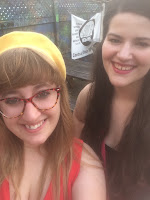
Best friend Erin and I at the Cults/
Shacks show, 2018.
Obviously, from the title of these articles, I am fast-approaching thirty. I'm not really upset about it. I love my life, I enjoy "adulting," and I never really reached the wild part of my youth and I'm okay with that. I have to say though, there is something comforting about this album. It's a message that we're getting older but everything will be okay. Just like MGMT's Oracular Spectacular came out just before I went to college, and ended up being the soundtrack of the late teens for many nihilistic youths, I think this album has a special place for people of my generation. Millennials have been accused of having Peter Pan syndrome (which I'm sure had nothing to do with the constant barrage of media that taught us that adults were boring and not to be trusted, living lives devoid of fun and color. Seriously, watch a '90s cereal commercial and tell me I'm wrong), and I think this album is a warm blanket telling us that it's okay to grow up. We don't have to look at relationships, raising a family and "adulting" as chores. They can be just as fun as anything we did as kids or young adults if we just approach them with the right mindset. 

I also just really like this album. It's fun and meaningful. The piano is gorgeous, the guitar work is great, and the drums add just what the songs need. Both of the songwriters in the band do great work and Thornewill's voice is incredible. I wasn't a fan of Jukebox the Ghost before this album, but now I eagerly await their next project.

That leaderboard is almost full, let's check in on it!


Join me tomorrow for my favorite album from 2019.